Monday, July 1, 2019

Innovating inside the box (but maybe pushing out the walls just a little bit) #IMMOOC Week 3

“What if we recognized and built on learners’ strengths?”


It’s a simple question, and it seems easy enough to do, but it forces me to think about this box within which we are innovating. I can’t help but feel like it’s a bit crowded in here. Do you feel it? Maybe we should push those walls out just a little bit; what do you think?


Image result for breaking out of the box


I absolutely understand that we can’t overhaul the system, but we also can’t afford to use that system as the excuse to shy away from new and better ways of educating.


This MOOC is all about communicating, sharing ideas, and learning from one another so that we can all be better learners, and in turn, guide our students to more meaningful learning as well. If I innovate over here, and you innovate over there, and someone else innovates between us, we’re bound to create enough energy and excitement and possibility that the box will be forced to open.


George’s comment about grading and reporting in chapter 7 struck me as a box-opening type of statement:


“I think we spend too much time documenting what students know and not enough time empowering them to invest in their own learning and helping them understand their strengths and areas of growth.”


I’ve been thinking a lot about the ways in which we communicate progress to students, and I can’t help but think that grades are an outdated mode of reporting. When I think about grades, I think about one of my favorite TED talks. Chimamanda Adichie discusses the danger of a single story and the ways that limited exposure can be detrimental to our understanding of ourselves and our world.


As a child, Adichie mostly read British stories even though she grew up in Nigeria, and so when she wrote, her characters were more like the characters she read about rather than the people living around her. “What this demonstrates, I think,” she explains, “is how impressionable and vulnerable we are in the face of a story, particularly as children.”


When she was finally able to read books by African writers, her thinking shifted: “I realized that people like me…could also exist in literature.”


I worry that sometimes our “underperforming” students feel that already their identities have been set for them. They feel that school is not a place “for” them because their interests and passions or ways of learning might not be represented there, so they get by without getting excited. They’ve been given access to resources that might only elicit mediocre responses from them, and so, they are awarded with mediocre marks.


“So that is how to create a single story,” Adichie explains. “Show a people as one thing, as only one thing, over and over again, and that is what they become.”


Do we want to create mediocre people who see themselves, sadly, in a single percentage? Or do we want students to know deeply that there is not just this one, single story of who they are in their learning — that they are, in fact, multifaceted and multi-talented in ways different from the student sitting next to them?


As Adichie points out, children are impressionable. It’s important that we take seriously the ways in which they develop their identities, and while  I think that sometimes grades can certainly boost a student’s confidence, there are also often times that grades don’t accurately reflect what a student can do. Grades can tear a student down and damage him or her in ways that can have lasting negative impacts.


I don’t think we want to tell our students a single story of themselves. Instead, “what if we recognized and built on learners’ strengths?” Let’s push a little on the walls of this box.


Getting (un)comfortable with innovation: Week 2 of #IMMOOC

Control is comfort. Think about it: When we are in control, we feel comfortable because the path is directed by us. After all, what can go wrong when I am steering the ship? Of course, I’ve made a bullet-proof travel plan, I’ve got an average of 1.5 life vests per passenger (because safety), and lots of extra supplies in case we have to divert around a storm. It will be the perfect trip because I am perfectly planned. Right?


Wrong.


Let me tell you who feels good about this trip: me. The captain. I am steering the wheel and staying the course no matter what comes our way. But my passengers? They’re not having fun. They’re seasick and tired and are kind of thinking about jumping ship and taking those life vests with them. They haven’t given any input into the plan. Maybe they felt we needed to stop at an island along the way? Maybe the supplies I brought are bland and they know a fun little stop where the supplies are bold and diverse. Maybe they know a faster route, or maybe they all want to take different ships to get there? Why won’t I let them?


We have lots of reasons why we say we shouldn’t let our students take their own wheels and steer their own ships. We think they aren’t ready, or they seem unmotivated, or (insert any number of excuses here). More and more, though, I realize that it isn’t that they CAN’T take control; it’s more that I can’t seem to let them.


As a teacher who desperately wants my students to love learning and grow academically, socially, and emotionally, I feel better when I have a perfect plan, but what I learned in the #IMMOOC reading this week is that rather than having the perfect plan, I need to ask the perfect questions. And then, I need to let each student come to the answer in his/her own way while I help them all get there in whatever ways I can.


Innovation might feel uncomfortable at first. After all, if we are thinking and working in NEW and BETTER ways, that means we are constantly changing, and we’re told that change is often difficult. But what if change was the norm rather than the occasional occurrence? Life would be so much better if uncomfortable could be comfortable.


Maybe I’m ready to take off my captain’s hat after all.


Raising chickens taught me more about education than my schooling ever did.

Three years in the past my husband got here residence at some point and mentioned, “We should always elevate chickens.” It was a random remark that someway picked up steam within the weeks that adopted, and a month and a half later, we had constructed a coop and our toddler was selecting out child chicks to take residence.


Neither my husband nor I had any experiences elevating chickens. He grew up in Milwaukee, and although I grew up in cornfields, my grandfather had given up cows, pigs, and chickens earlier than I joined the world. On high of that, we lived in a newly developed neighborhood in suburban San Antonio — not precisely rural dwelling.


There have been a number of causes we shouldn’t have taken on our hens: we had by no means accomplished it earlier than, we knew nothing about their wants, we had a small yard, and our home-owner’s affiliation strictly forbade livestock. Nonetheless, we spoke with our neighbors (who agreed to maintain mum if they may have recent eggs), discovered plans for a coop, learn blogs and watched movies, and out of the blue turned the neighborhood specialists on elevating wholesome egg-layers. And we liked it.


When individuals discovered that we raised chickens, I can’t let you know what number of instances they mentioned, “You don’t appear like a rooster particular person.” At first (and surprisingly), I took this as a praise. Their faces and tone appeared to say that rising chickens was a lower than fascinating option to spend one’s time. However after concerning the twentieth time of listening to that, I began pondering: What does it imply to “appear like a rooster particular person?”


I started to surprise if that very same pondering was occurring within the minds of the kids in my very own classroom, however in a distinct context. Studying the primary chapter of The Innovator’s Mindset by George Couros solely solidified my concern: What if I've created an atmosphere the place college students really feel they don’t match the outline of pupil? What if the methods they crave to study aren't the methods I'm permitting them to study?


On the primary day of college this yr, fairly than go over insurance policies, procedures, and the syllabus as I've up to now, I wrote a query on the board: What does it imply to coach? The category brainstormed concepts largely consisting of the notion that schooling is centered round an individual delivering the schooling. They talked rather a lot about lecturers in class and studying from speaking to their associates. After we created a listing, the scholars had free reign to make use of any sources the varsity offered them to be able to develop their understanding of what it means to coach; they may use Chromebooks, different college students, lecturers, directors, custodians, librarians, books, and many others.


Each pupil practically jumped out of his/her seat after I mentioned it was time to go examine and interview their sources. When it was time to return to class and share their favourite definitions, they shared issues like “to supply a possibility for one more particular person to study,” “to broaden your worldview,” and “utilizing instruments to enhance abilities.” All of their favorites had been centered across the pupil now as a substitute of some supposedly all-knowing schooling deliverer. Once they synthesized their favorites and wrote their group definition of schooling on the board, all of us realized that being pupil shouldn’t look the way in which we’ve all the time allowed and inspired it to look — a pupil, in a desk, hand raised, ready to see if what they assume is right. Being a pupil, because it end up, can look nevertheless every youngster desires/wants it to look, and in that method, no pupil ought to ever must really feel that they don’t match the invoice of pupil.


I'm so grateful my husband adopted his curiosity three years in the past. We purchased three hens in Texas, after which 25 chickens after we moved to Illinois. We went from one small coop to a few coops and an enormous free-range pasture. And now, we breed our personal chickens. I by no means imagined our curiosity may take us this far, and I’m excited to know that we nonetheless have a lot extra to find.


Because it seems, I suppose we do appear like rooster individuals. And for the remainder of my life, my purpose as an educator is to not uphold the age-old definition of pupil. As a substitute, I would like my college students to put in writing themselves in as new and completely different entries to an previous, previous phrase.

Innovating Together: My First Lesson in Co-Teaching #IMMOOC

“My mother always said, ‘If you’re not striving for the ideal, you’re not working hard enough.’”  – Roni Riordan


together

Image from pixabay


This week in the #IMMOOC, there was a lot of mention of designing the ideal. This fall, I will have the opportunity to move toward my ideal for school. A colleague and I will be teaching a combined English III/American History course that allows students to take control of their learning and choose the way in which they are assessed. When the course was approved, I was ecstatic, but that enthusiasm quickly transformed to panic when I realized I would truly be working with another teacher. Another teacher. In MY classroom. Ehem, I mean, OUR classroom.


At the ICE Conference this morning, Adam Welcome said, “Teaching really isn’t that collaborative.” We ask our kids to collaborate effectively and we preach that this working together is the way of the future. But we don’t do it very well in schools. I realized this myself when my panic set in about sharing the room with another adult — even when it was a colleague I admire.


Chris and I (my future partner in co-teaching) had our first planning meeting last week. There were two main takeaways that I wanted to share this week that might help others take the jump from innovating in a bubble to innovating together.


Be open minded:


In our first meeting, Chris said, “I want to share with you what I already do, but I need you to know that that doesn’t mean I expect to do things the way I have been doing them.” Wow. I consider myself pretty open-minded, but what that did for me was help realign my expectations for myself — that I should expect to change because he was expecting to change and grow, too. Eric Sheninger reminded us in his keynote this morning that “change is the only constant.” I am thrilled to be working with someone whose mindset is focused on being better.


Choose to work with those who challenge you:


I’ve long believed that the most important assessment is a project or product, not a standardized test. Yet, I have still given standardized assessments as part of how I assess students and “prepare them” for the inevitability of “the system.” In our meeting last week, I said that to Chris. His response: “Why?”


I had to think about that. And all my answers were about me. I want my students to score well. I need my kids to be familiar with the types of tests that schools require of them. Did you catch that? I want. I need. It’s about me. Because really, my kids don’t care much about the tests. They care about learning. In the words of Adam Welcome, “The kids should BE the conversation.” My dialogue was focused on the wrong stakeholder, because in the end, the stakeholder that really matters is the child.


“The kids should BE the conversation” – Adam Welcome, #KidsDeserveIt


Co-teaching, interdisciplinary learning, and student-led learning are huge aspects of my ideal, and even though I feel strongly about that, it’s still hard for me to take the leap. But how can I ask my kids to take risks if I’m not willing or enthusiastic to model that for them? It’s about the kids, yes, but it starts with me. And that’s a huge but really important responsibility to follow through on.

My students wanted to make their own final. When I let them, they did more than “exceed standards.”

In late November, my Mass Comm students and I were reviewing the finals schedule. One student asked, “What will our final be in here?” Every kid in the room had a puzzled (and somewhat concerned) face as they waited for me to answer.


I had to admit pretty quickly that I wasn’t sure. The previous year, the students in that class had written a blog post for their final. They had a detailed rubric with lots of writing and tech requirements, and they enjoyed it, but my class this year had already started blogs, and I wasn’t excited about just doing something similar because while we do blog in class, we do a lot more than that. They write the school newspaper, plan professional development on apps for teachers, sell advertising to area businesses, create digital stories, and pretty much take on any project they can find. How could I possibly assess their learning on all of those things in one traditional final?


The truth was that I couldn’t. And the kids knew that just as well (if not better) than I did. One girl raised her hand and asked, “Can we make our own finals and just show you what we’ve learned?” Each student nodded hopefully in agreement.


Absolutely.


But we had to do some brainstorming first. I gave the kids five minutes at the end of class to do a group quick list of the things they thought they’d learned in the semester. This is what they came up with together.


screen-shot-2017-01-28-at-3-09-33-pm


These were great ideas but big ideas. I wanted to make sure they could narrow this down to specific things and also be able to show their progress in those areas. We sat together and came up with some requirements, and everyone had a voice in deciding what was important to show, including me. We all agreed that all things informative writing, multimedia, and presentation were important. Creativity was a must.


I wrote up the assignment and shared it with them to make sure I hadn’t missed or misunderstood anything. In it, I also included some hyperlinks so that they would feel challenged to really be creative and try producing something completely new for them.


After we went over the assignment, the kids only had one question: “Can we start now?” They spent the next two class periods (and time at home and in homeroom) working on these projects. I couldn’t believe their enthusiasm, and I got to spend all of my time during class checking in with them, giving feedback on their scripts, helping them self-assess progress with their rubrics, trouble-shooting equipment problems, and learning new apps they planned to use to present. My teaching was truly based on their group or individual needs, and most importantly, I saw their critical thinking in progress, and got to provide feedback on those skills as well as their writing and technology content skills.


The day of the final, there were no nervous faces, and there was no last minute cramming. The kids were so excited to share what they had produced. They supported each other like no other group of kids I’ve seen before, and they gave honest, constructive feedback (based on standards from the rubric) after each presentation. They evaluated themselves using the rubric as well, and their assessments were shockingly accurate. I had never felt more effective as a teacher, and all I had really done was give them the opportunity to choose their own path. They felt empowered to do more, so they did; it’s amazing what can happen when we hear and trust our students.


To my Mass Communications class: Thank you for pushing me to give you more opportunities and for your drive and commitment to make your world a better place. I’ve learned just as much (if not more) from you than you have from me, and your influence will stick with me long after you’ve left this class.

An open letter to my seventh graders after their standardized tests

My wonderful, unique, 7th grade humans:


Today you finished up your winter MAP test. It’s results are supposed to show your areas of strength and weakness, providing you and your teachers with valuable feedback regarding your instruction. Some of you were jubilant about meeting your goal and showing how much you have learned since September. Others of you made growth but felt self-conscious that you didn’t hit the goal you set for yourself, or worried that your score was “still too low.” And some of you didn’t “make growth” this time around. I watched your disappointed faces as you finished your tests, and I watched the confidence you’d built all year slowly dissipate because of this one number.


Now, I don’t know everything, but there are two things I do know for sure: 1) You are not defined by a number determined by the answers you select on a multiple choice test, and 2) You have made more growth these last few months than a test could ever begin to show you.


Let me start by explaining that you came to my classroom this year already wonderful. Your parents and grandparents and aunts and uncles and family frieKids working.jpgnds and previous teachers who all play a role in making you the people that you are have done an outstanding job. You are kind, thoughtful, enthusiastic individuals. You have empathy, and when someone else is hurting, you do whatever it takes to help alleviate their pain. Do you know how incredible that is? So many adults struggle to be compassionate when someone else’s experience or background has been different from their own, but it seems to come so naturally to you. The resilience you show when something doesn’t go quite right the first time is so admirable, and you’ve taught me that — to never give up and to always come back stronger and with a new plan after a day that tests me.


And throughout this year, you have only become even more impressive learners and people. You’ve kept the empathy, generosity, and kindness you brought with you, but you’ve also become some of the greatest critical thinkers I’ve ever had the pleasure of teaching. When you write, you write about things that matter, not just to you, but also to your classmates and to me. You see the heart of a story, and you understand that writing isn’t meant to be formed from a prompt — it’s meant to deliver a message others need to hear: of hope, of change, of pain, of resilience, of love. All of you recognize that reading is a vehicle for exploring your passion, not a task of which the purpose is to determine your supposed ability.


You are not 210, 237, 205, 223, or 214. You are so much more than a score, and you are anything but average. You exceed my standards for what students should be every day. You take charge of your learning, inside the classroom and outside, and that motivation is the true determiner of success in life.


Keep striving to do well on these tests. Knowing how to survive or thrive in tasks that feel overwhelming is such an important life skill to master. More importantly, though, continue mastering these most important traits: caring for others, loving yourself, engaging in respectful debate and discourse, and reading and writing to learn. Aristotle said that we are more than the sum of our parts. What you do with the skills you learn will always be more important than having the skills themselves.


Keep doing. Keep creating. Keep changing your world. And know that I am proud of you — each one of you.


create

Image from flickr

Why blog?

This fall, I joined the Innovator’s Mindset MOOC after some serious urging by our district’s Instructional Tech Director. The facilitators of the MOOC encouraged participants to blog about their learning as they read and then share their posts and comment on others’. Even though I write constantly for myself and coach kids in writing every day, I was skeptical about taking the time to set up a blog and put my writing out there for others to read, use, and maybe even criticize. Wouldn’t writing in my notebook have the same reflective value? What could I have to say that someone else wasn’t already thinking?


blog


Two weeks into the course, I had a little chuckle to myself when I realized that I had gone against everything I knew about education when I doubted what blogging could do for me. I preach that learning is doing, and yet, I was hesitant to “do” blogging and see what I was capable of producing.


When I started reading others’ posts and receiving comments on mine, I realized that blogging isn’t about saying something that no one else had ever said or thought before; it is about connecting, relating, sharing, and growing. I think the whole point is to say what other people are feeling — to give voice to a common thought, issue, or concern — and then come together to share ways of improving.


This is why blogging is good for any subject, but especially education.


I have always felt that teaching can be isolating, which is ironic because I’m surrounded by people all day, and by nature, my job is pretty transparent. My administrators are in and out of my room all the time, and the kids share what is happening in all their classrooms. But there are not many opportunities for me to bounce my ideas off of other professionals and have a lengthy troubleshooting session during the school day.


It’s tough to match the quality of face time with a trusted colleague, but to be able to come home and fully process my thoughts, write them out, and then share with a wide audience of people as passionate about their work as I am is as close as I’ll probably ever get. Blogging is limitless. I can connect with any person who happens across my little corner of the internet, and if they share it online or even with a colleague, my corner gets a little bigger. Suddenly, my community isn’t just the people I try to squeeze in conversations with during the day; my community is a web of people that read what I share and share their thoughts for me to read, too.


In that way, blogging completely changes the way I reflect on my teaching. I teach my kids that writing is a way of learning, and again, it’s important for me to practice what I preach. In class, my students self-evaluate and peer-evaluate. They often say that hearing from other students helps them recognize things they wouldn’t have noticed before. Blogging does that for me, too. Reflective writing for myself is still really important, but like my students, I’m noticing that sharing it increases the benefits tenfold.  In the words of AJ Juliani, “When you write what your heart tells you it will always have a dual impact. The reflection impacts us personally, and also those who read it.”


A few months ago, I had countless reasons why I couldn’t blog. Now that it’s part of my practice, I can’t think of one.

Embrace the new

I constantly hear teachers talk about educational trends as a metaphorical pendulum. It swings back and forth every ten years or so, reintroducing previous ideas rebranded as something new, shiny, and necessary for students’ success.


My tenure in education is not yet a decade deep, so I haven’t experienced the pendulum swing myself, but I do know that when teachers are excited and enthusiastic, kids are more likely to perk up and get involved in their own education as well. Maybe the whole point of rebranding something old is less about introducing something better than before and more about getting people excited again so that they can transmit that energy to students. After all, when you see the same scene over and over again, it gets a little boring, but if you view that scene from a slightly different angle, an entirely different world can emerge.


Sometimes as teachers, though, we fail to see the “entirely different world” because we feel so overwhelmed that we don’t think we have time to look out the window, let alone look outside twice — from two different windows, no less! And when we get overwhelmed, we get a little… negative. While I’ve certainly been guilty of attending (and even hosting) the frustration-with-education pity party, I also know that dialogue gets us nowhere. Here are a few practices that can help minimize the education pendulum whiplash.


embrace-the-new


See the good before pointing out the bad.


Today I was totally overwhelmed. My calendar is filled with IEP meetings, ELA PD, and testing over the next three weeks, and I need to get evaluated sometime in there. On top of that, I just started three new units with my classes this week, and my Mass Communications students need to finish final drafts of their articles so that we can get the newspaper to print by next Saturday. And that’s just my professional life.


So today after school when I walked into my Future Ready meeting, I was mentally listing all the things I needed to be doing instead. I came in with a negative attitude; it felt like one more thing I needed to do instead of the next great thing I got to do. And yet, we had a productive meeting. I got to sit next to my sister, who is the teacher and person I have always admired most, and when I left, I felt like I had more direction for myself because I was reminded of the vision we have for students. So tonight, I’m excited again about all the busy because all of it boils down to doing better for kids. And that’s my job. Can you imagine how much I could have offered and gotten out of that meeting had I thought of the positive outcomes first?


When presented with a new opportunity to improve student learning, make a promise to yourself that you’re going to find all the good first. My guess is that after listing all the potential positive outcomes, you’ll find that any downfall pales in comparison to the benefits for kids. Immediate excitement will replace temporary negativity.


Be a problem finder, but show up with a solution, too.


If you consistently showed up to a potluck with friends sans dish to pass, do you think you’d continue getting invited? Probably not. Even worse would be showing up with liverwurst every time.


This is what happens when we constantly bring problems to attention without providing any positive, concrete solutions. Pretty soon, we’ll find ourselves without a seat at the table. George Couros (and lots of other really incredible educators) see the obvious value in being a person who can recognize real issues, but problem-finding can quickly equate to complaining if there is no action suggested to resolve the issue.


If you’re going to be a problem-finder, be a problem-solver, too.


Know that you don’t have to know everything to get started with a new practice.


The true beauty of the age we live in is that information is easy to come by. When I was in middle school, if I forgot my textbook at school, I was calling (on my landline phone) to every neighborhood friend begging (read: sobbing) to borrow the book. The book had ALL THE ANSWERS! If I were to pull a textbook out in class now, it would be because all of the power in the universe had been consumed and our Chromebooks were dead. If my students want to use a new app, and I don’t know how to use it, we find a YouTube video or an online tutorial and we figure it out together. If I’m busy helping someone else, sometimes the kids just teach themselves without a resource and then they get me caught up later.


I don’t have to know everything to help my kids learn that they can learn anything they want. And if we really want them to view learning as a lifelong, enjoyable endeavor, it’s best that we don’t pretend to have all the answers.


Develop the lesson for the consumer


Probably the most important thing I have ever done as an educator was ask my students what they wanted. I’ll never forget the first time I did this. I was using a poetry highlighting strategy to analyze “One Face Alone” with a group of Pre-AP 9th graders. We had done it before with other poems, and the kids had responded well, but this time they didn’t seem into it. I stopped and asked them if something was wrong. One very straightforward but sweet girl in the front said, “Mrs. K, I don’t know about them, but I’m tired of doing it this way, and I’m not a huge fan of the strategy we learned yesterday.” When I asked how they’d rather do it instead, they wasted no time coming up with new ways to get to the same outcome: analyzing the poem to be able to write about it. I couldn’t believe how fast they came up with the ideas, but in actuality, they’d probably spent most of their lives in education dreaming of the ways they wished they could learn in school.


As I milled around the room, I saw that they were all working in different ways but coming to many of the same conclusions about the poem, and I got to spend time working with kids instead of asking questions from the board. It wasn’t my idea, but it was better.


I’ve never forgotten that day, and so whenever a new idea in education arises, before I think about how it affects me, I think about how it affects the consumers: the kids. If it would benefit them — prepare them better for the world in which they’re going to be leaders — I’m trying it as soon as is humanly possible. And I’m sharing the why with the kids so that they see it as the new, exciting opportunity that it is.

Are we teaching kids to answer or ask?

Tonight I was reading a blog post titled About assessment: Why are they raising their hands? In it, educator Donald Gately writes about a potential future conversation with his grandchildren, and they are confused why the children in old movies are doing silly things like raising their hands. His point is to say that these archaic behaviors will be — one day not long from now — more than somewhat mystifying to anyone examining them. Their future exchange is hilarious, but also carries a serious undertone for educators:


Grandpa, why do the kids keep putting their hands up, usually the right hand…


That’s what they did when they wanted to ask or answer a question.  You also did that when you wanted to go to the bathroom.


Could they use their left-hand?


I guess… most kids were right-handed.


What happens next?


Well,  the teacher would point at a kid, say his or her name, and the kid would answer the question.


How did the teacher know if the kid was going to give the right answer?


The teacher didn’t know?


So what did the teacher do when a kid gave the wrong answer?


Well, teachers took classes called Questioning Techniques on how to handle when students gave wrong answers. They’d say to some other kid, “What do you think of Johnny’s answer? — Anyone want to respond to Johnny?”


Wasn’t that embarrassing for the kid who gave the wrong answer?


I guess so, a little bit, but the class the teacher took was intended to help figure out a way to avoid that.  Not really sure it worked.


What about the kids who didn’t raise their hands, or the kids who had their hands raised but didn’t get pointed at? How did the teacher know what they were learning?


Um, I guess the teacher didn’t.  But some teachers gave points to kids who frequently raised their hands.


So then, didn’t many kids just raise their hands a lot to get the points.


Um… I don’t know… I never thought about that… You think they did that?


Grandpa, I’m sure kids did that.


What was the purpose of the kids raising their hands all the time? Was it for exercise? Did they have physical education classes back then or was it combined with other classes that they took because of the hand raising?  Did their right shoulder muscles get all big  out of proportion because of all the hand raising?


Well, I know the hand raising was a form of formative assessment for the teacher but you’re really making me think about this now.


It looks like school back then was a little bit like that show you like to watch, what’s it called? With that guy who never seems to get older, Alex Trebek?


Are you talking about Jeopardy?


Yeah… School back in the day was like Jeopardy wasn’t it grandpa?


Here’s why I say the undertone is serious: Do I want my classroom to be like jeopardy? While entertaining (for some) to watch, what does all that stored information translate to in terms of skills? Memorization of facts doesn’t equal skillful, more often than not. And can facts change? A question for another day…


So do I really want my kids sitting around the room answering questions? Sure, if I ask a quality question that requires them to think critically and evaluate and analyze, they are showing me their skills, and they are pushing to learn something new, but after the conversation moves in a different direction, they may not all get as much out of the discussion. Some kids might not be participating at all because they aren’t interested in the topic or haven’t done the lesson prep or maybe haven’t slept or eaten or had a warm place to rest. If they don’t care or can’t care about it, the quality of the questions matters very little or not at all. They are only talking one at a time. In a class period, that leaves little interaction per child.


On the other hand, if a child is asking the questions — is genuinely curious enough to ask a question, and another question, and another question — there is more learning taking place there. That child is pushing for more information, building their own questioning skills, clarifying their thinking, and building upon a framework that is their own. When they can work independently or with a small group, they can ask a lot more questions and get more interactions than they could in the whole group, hand-raising situation. A question answered implies the learning is done. A question asked signals the beginning or the building of momentum.


So we need to give students opportunities to ask the questions they already have. And if they don’t know how to be curious or ask a question because school has inadvertently (or maybe kind of accidentally on purpose) taught them not to, we reteach them the curiosity they had before school taught them to answer instead of ask.


ask-more


3 Essential Traits of an Effective Mentor #IMMOOC

I’ve been in education for six short years, but I have been fortunate to be mentored by a number of incredible educators. I know that not everyone shares my experience; several of my teacher friends have lamented that they haven’t gotten much out of the mentoring program in their districts or that they weren’t given much guidance when they became an assigned mentor to a new teacher. I don’t think, though, that becoming an inspiring mentor requires a 30-hour training or a certain number of service years. In my experience, teacher-leaders just need 3 key traits to empower others.


1. Mentors share.


This might seem like a no-brainer, but when I say that mentors share, I don’t mean that they pass on lesson plans or tried-and-true strategies, though every once in a while, that certainly helps! Mentors share their passion for learning and facilitating. They understand that they don’t know it all, and so they come to mentorship as a partner — someone to work with rather than under. And when they experience a struggle, they are transparent without being negative. They model the attitude that there is no problem impossible to solve, and they actively seek out alternatives when one possibility doesn’t work out.


When I became a student teacher, my cooperating teacher shared her classroom and her passion, but Susan also shared with me a gift much greater: confidence. As a co-department chair, Pre-AP teacher, and a teacher of a state-tested grade, she had lots of reasons to keep a watchful eye and give pointed suggestions. Instead, she trusted me completely (or at least pretended at first!). Knowing that someone else trusted me to teach her students made me feel confident in my abilities, and as a novice teacher, there is no gift shared more beneficial than that.


2. Mentors listen first, then coach through noticing and questioning.


Anyone in a position to lead others should spend 70% of their time listening, 20% asking questions, and 10% making observations. Did you notice that none of that time should be spent giving advice or solving problems? In our classrooms, giving students answers to questions generates dependence. The same becomes true with adults. If we want to develop teacher capacity, we have to make teachers feel capable to come to solutions independently. The way to do that is to guide them there until they don’t need to be guided anymore. George Couros, in his book Innovator’s Mindsetexplains the importance of teaching to strengths first. Influential leaders know how to help others discover strengths so that they can capitalize on those and develop a framework for improving areas where they see opportunity for growth.


My former ELA coordinator, Michelle, is the perfect example of someone who guides people to greatness without prescribing. One of my favorite memories at my former school was the moment my entire team realized we had been teaching a standard ineffectively because we interpreted it incorrectly. We looked over our common assessment data more than a little flabbergasted that one of our easiest standards was so often missed. Michelle was in our PLC meeting and asked a few simple questions. Almost instantly, we discovered our error. Then, rather than tell us how to teach that standard more effectively, she listened and supported us as we brainstormed new methods. Because of her, I not only understand how to use data effectively, but I also recognize its value.


3. Mentors are never “done.”


Susan and Michelle are still people that I go to when I have a question or need some guidance, even though I am not a new teacher anymore. In fact, I left that district (and that state) when my husband received orders almost two years ago, and yet, they have never said they can’t/won’t/don’t have time to help me or hear me out. Good mentors understand that support and relationships are what make a strong team. When colleagues are in constant conversation about their craft and practices, that dialogue helps everyone grow. If the goal for our students is continuous growth, shouldn’t that be our goal for ourselves and each other? Effective mentors see the big picture and know the job is never done because there is always more to learn, try, and share.


The day I threw out my lesson plan #IMMOOC #writing

On Tuesday, November 8, I did what I do every day. I came into my room and typed out the essential question of the day for students, and set up for writer’s workshop on our most recent writing project because that is what I had carefully planned for the day.


And then my sophomores walked in.


“Mrs. K, this election is going to be crazy,” one commented. “Can we watch the news? I want to see what they’re saying.”


Lately, I’ve been focusing on really listening to what my students want and need. I used to ask them for written feedback multiple times a year, and I felt that that was helpful. I would immediately share the things I thought we could make happen (more group time or more independent projects) and explain carefully why certain requests were non-negotiable (their requests to eliminate writing were always equal parts hilarious, maddening, and saddening for me, but that’s a post for another day). But that feedback wasn’t instant; often I had already missed lots of opportunities to provide them with better lessons.


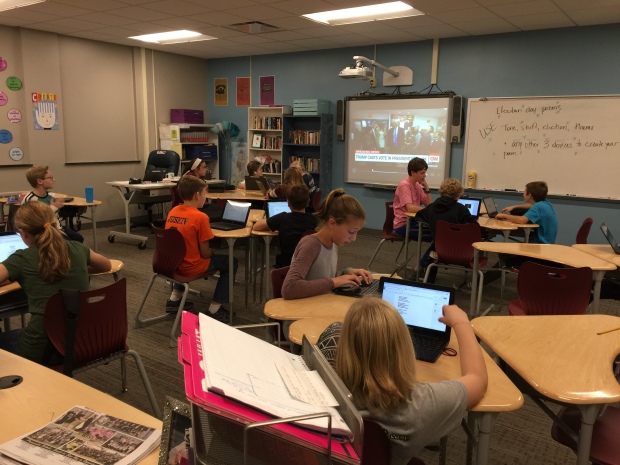
So when all of my students echoed that request, we went with it. I logged into my cable account and put the news on my SMARTBoard. Then, we had to decide how we would measure our learning.


We are in our poetry unit, and at the beginning of the unit, kids activated background knowledge about poetry by completing a project, and most students came to the conclusion that poetry is about using emotion to convey a message. This campaign had certainly evoked some emotion from Americans, and so poetry seemed to be a good fit.


“Write a poem about it,” I said. For the next five minutes, we had lots of blank screens. Students weren’t sure where to start. None of the prewriting activities in our toolbox felt like a good fit.


I knew that the kids were struggling to understand how diction creates a strong tone in poetry, though, and I also knew that the media is well-versed in word choice, so I modeled. “Okay, let’s all listen for a minute and write down any words we hear that stand out to us.” Pencils scratched and keyboards clacked away. Soon I had a list of seven or eight words, and I separated them into groups. The kids seemed to understand what I was doing. I was organizing my words so that the shift in my poem might be created more authentically through diction.


So we watched, listened, and wrote.


IMG_2592.JPG


Kids were not just engaged, they were empowered to share their thoughts and opinions. They asked so many questions of me and of each other. It was energizing, and they didn’t struggle to include figurative language and other literary devices. It came naturally for them. They crafted their writing purposefully, which is what I strive to teach them to do every day.


They posted their finished poems in the window of our room and they raced to do it! Here they were, anxious to publish and share their poems with their schoolmates. Throughout the day, students brought their friends by the window to read poems; their learning spilled out of our classroom.


Perhaps the best thing that happened that day was that students discussed some controversial topics with emotion but also with empathy. 7th graders, freshmen, and sophomores felt comfortable sharing their opinions and using respectful discourse more than most adults I’ve witnessed in the last few months. They didn’t avoid the tough topics — they just understood that their opinions and experiences mattered as much as anyone else’s.


I continue to be amazed at what can happen for my students when I trust them. They want to learn, and I believe that’s true of even the most seemingly apathetic students. When they are the experts of themselves, why wouldn’t we ask them what motivates them? I’m learning that they often know better than I do.


The end is really just the beginning. #IMMOOC week 5

Over the last few weeks, I have noticed a huge change in myself, both as a person and as an educator. It is amazing what fueling your passion can do for all aspects of your life. I have had more energy for my family, for my students, and for myself, and it hasn’t been an energy burst — like the kind I need for a week or two when I have a lot going on. That type of energy isn’t sustainable, and when the busy weeks are over, you’re left feeling empty — drained. The energy I feel now fills me up and keeps me constantly pushing for more. If I was asked to explain what innovation does for a person, that is how I would describe it: fulfilling in innumerable ways.


I was not sure I wanted to do this book study. I am a reader, and even as someone who loves to read and is passionate about my career, I feel like I am always working. It felt for a long time that if I was doing well at work, I was failing at home and vice-versa. The worry that taking on something else right now would only add to that problem almost kept me from dedicating the time. But when a friend and colleague encouraged me to read the introduction because she thought it would resonate with my philosophy, something inside me whispered just loud enough to tip the scale, so I dove in and finally posted on the blog I created months ago and never got around to working on.


One of the major things this book and book study has taught me is that we are better when we take the time to grow ourselves. It seems so hypocritical to write that because as teachers, we push our kids every day to be better, but the truth of it is, sometimes we don’t always know how to do that for ourselves. We rationalize that we don’t have the time, but the truth is that it feels selfish to be doing something for ourselves when we think we should be doing more for our students. We often fail to realize that those actions are one in the same. After all, how can we teach learning to learn if we aren’t ourselves learning in ways that are relevant to the current world?


Brad Gustafson used a phrase last week that struck me: “one on one endeavor of the heart.” So often in schools, “learning” becomes not an endeavor, but a chore. And sometimes our jobs as teachers can feel that way, too, and there are lots of reasons that can happen. But it doesn’t have to happen. Sometimes we are scared to change our ways for fear that that means we’ve been doing it “wrong,” when in reality, we need to see every iteration of what we do as a step towards something better, even if that something better is always changing. That doesn’t mean we’re “throwing out the book” of our past experiences and successes. It just means that the book is a living document and we get to add to it all the time.


I’ve realized that all the things I want for myself in my job as a teacher are all the things my kids want as students. We all want the freedom to explore our passions. We all want our relationships to be built on trust — not the lack of it. My students want to be heard, just as I do. So I’m doing more listening, more asking, and giving more freedom. They are still learning, but it’s more authentic learning. It’s better.


This MOOC has also pushed me to address my major weakness, which has been difficult. When my husband and I moved here a year and a half ago, I swore I would make an impact without getting too attached to my new school and colleagues. As a military spouse, I have lived in four states in almost six years of marriage. I have had to leave students before their school year is over because my husband received unexpected orders, and as someone who cares deeply about the kids I teach, that has been heartbreaking. It felt like I was abandoning them. And even though we hope to stay here for a long time, I know that things can change in an instant, and it has crushed me in the past to leave close friends and colleagues that I love and who have made me the teacher than I am.


But I realize that I can’t do that anymore. I can’t be all in for kids without being all in myself. And the truth is, I have hated not feeling as connected to my school community. I don’t let go of relationships easily. My closest girlfriends live all over the country, but we keep up weekly (and sometimes daily) with text messages and phone calls. We schedule trips every six months to a year and take turns coming to see one another. We invest the time, the money, and the inconvenience because we’ve been through experiences together that not many people have. I pledged to myself that I wouldn’t get attached here, even if that meant I would go against my belief that relationships are what matter in life. I convinced myself it would be better, and as it turns out, I was wrong.


So even though this MOOC is ending, really, I think this is just the beginning for me. I’ve built on my strengths and solidified my philosophy, but I’m also coming back around to something I knew all along but needed some strong reminders to renew. We can never reach the end of innovation, and I’m thankful for the forever journey.

Innovation makes me cry. #IMMOOC week 4

This week I took a little break from the study. It wasn’t intentional; it just kind of happened after a weekend away with my family and then a busy week to end the grading period (while simultaneously beginning a new unit). In that time, though, I applied so much of my learning in this space to our classroom practices, and the outcome left me, well, in tears.


We began our poetry unit in 7th grade this week. Usually, I begin this unit with a day to begin answering our first essential question in the unit: What is poetry? It’s an effective day to build background knowledge, but seeing as poetry is a mode of writing that is supposed to convey and evoke emotion, I have been disappointed in the past that the first day of poetry doesn’t mimic that same purpose. I want kids to be excited; usually, they are closer to mildly interested.


This week, I put four essential questions from our poetry unit up on the board:


  • What is poetry?

  • What is its purpose?

  • What are some elements of poetry?

  • Why does poetry matter to you?

The kids are used to beginning the day with essential questions, but when they saw four, already they seemed to know that our routine would be disrupted. We did our initial discussion on the questions, and then we watched a short video created using PowToon about the elements of a short story. We had just finished our short story unit, and I wanted to kids to be reminded of just how much they had learned about short stories while also seeing a model of  a new way to show their learning.


When the video was over, I explained that our goal over the next few days was to answer those four essential questions on poetry and show our learning in a new way. They could use any medium they wanted, but they should choose one that fit their purpose and helped them best organize their answers.


A few weeks ago, I told this same group of students they could create their character sketch for their original short story however they wanted as long as they showed their character’s personality through thoughts, feelings, words, and actions. I was not prepared for the anger and frustration they would express. “Why can’t you just give us a sheet to fill out?” said one student. Another student lamented, “It’s just easier when you tell us how you want it because then I feel like I have a better chance of getting an A.” They were worried they would “mess it up.”


I was shocked. I had thought they would be excited, but instead, they felt anxious. In the short few weeks I had taught them, I had already demonstrated learning as cookie-cutter, when I had meant to do just the opposite. We had a great conversation that day about how it doesn’t matter to me how we assess their learning together — each one of them is different, and given the opportunity, they can show their creativity better when they aren’t bound to one format of learning. So that day didn’t go quite how I thought it would, but it set us up for a smoother day the next time around.


This week, when I let them decide who they would work with or if they would work with someone, they began moving around the room immediately. They asked questions like, “I can really use anything I want?” and “What if you don’t know the app we want to use?” I got to respond with things like, “Yes, absolutely!” and “Well, then I guess we’ll get to learn something together!” They were excited now that they knew the fun and benefit of freedom could outweigh the comfort of compliance.


The greatest part of the day, to me, was that there was no struggle to engage students in the learning. They really felt empowered that they could do this and take ownership and still succeed. I got to help students through the essential questions and content one on one  or in small groups without sacrificing time with others to do it because they were all learning a new tool or researching poetry. There was no wasted class time for anyone, and students who normally don’t get enthused about language arts came to my desk multiple times to show me their work so far. They were always beaming with pride, and they were happy to struggle through some new concepts. They were teaching themselves to learn.


When the bell rang, I had to remind a few kids that it was time to go, and when they had all left, I sat at my desk and cried a few joyful tears. They hadn’t all used the same apps, and some of them didn’t use technology at all. They hadn’t followed a rubric either.  But I had seen each and every one of them learn. They were all confident in their abilities. They were engaged and building background knowledge while meeting our other learning objectives. As a teacher, I couldn’t have asked for a better day.

Technology isn’t the problem. We might be.

I realize that title sounds harsh, but the experience I’m about to relay highlights the unintended (and kind of terrifying) lessons we might be teaching our students, not just about technology, but also about life.


image1 (1)


A week and a half ago, George Couros, author of The Innovator’s Mindset and The Principal of Change blog came to speak at Peoriapalooza, the Peoria County teacher’s institute. Somewhere in his speech, he mentioned a school where access to online resources was so locked-down that the teachers went to the students constantly to access useful content from which they were restricted. Everyone laughed because: #truth.


Except that when it happened to me this week, I wasn’t laughing at all.


This past Friday, my kids edited an uncapitalized, unpunctuated version of this Dear John” letter as an anticipatory set to help them see purpose in punctuation for meaning. They loved it, grappling especially when they finally figured out how to make it a love letter, and I explained that now, they’d need to make it a break up letter. Their wide eyes and dropped jaws let me know that they didn’t see how ONLY changing punctuation and capitalization could make this happen. “We can’t rearrange or delete words?!” They didn’t think it was possible, but they figured it out, and all agreed that punctuation could be a game-changer. Of course, I was on cloud nine: the hook had worked!


The next part of the lesson was a content primer, so I had shared Terisa Folaron’s “Comma Story” and three other videos about sentence structure for a project my students are beginning. In slow waves as they finished notes on the first three videos, students started coming up to my desk to tell me the fourth one was blocked. Without thinking much about it (because this happens all the time), I e-mailed the link to our system administrator asking for it to be unblocked. But a few minutes later when they had just moved on to the next step, I wondered why they hadn’t used their usual tricks to get the blocked content.


My next two classes came in, and the same situation occurred. I let it unfold much the same, but when they started coming to my desk in the second class, I asked them to solve the problem. “Have you asked for it to be unblocked?” some asked. I had, I explained, but sometimes the system doesn’t update right away. They walked away and moved on to the next step.


When I finally asked if they knew how to get blocked YouTube videos, they all hesitated, but said that yes, they did. So if they knew of a tool to get content the school felt they shouldn’t be able to access, why wouldn’t they use that same tool to get content they knew their teacher had approved and wanted them to have? Cue the crickets.


I spoke to several groups of kids after that, and I’ve concluded that some of them didn’t use the tool to unblock the video was because they were scared to use it when they knew I was watching. They wanted to protect their tool so that they could continue to use it to get what they valued more: their music. And I can completely understand that thinking.


In far more cases, though, it never occurred to them to use it for class-related content, which to me, is the concerning part. Are we demonstrating through our actions that only pre-approved tools have value in our classroom rather than signalling that all tools can have impact while focusing on positive use? Will our kids leave our classrooms truly better for having transformative tools, or are our practices holding students back from life- and world-changing applications?


Have we inadvertently taught our kids that breaking the rules is reserved for what is deemed “wrong” or questionable  rather than for doing good or even just learning? I know we certainly haven’t meant to, but the consequences are still the consequences — intentional or not.

Hug your students

…or give them a high five. Or a fist-bump. Or a pat on the back.


img_6231


Every morning starts the same way for me. I drive my daughter and I to school, we drop my things in my room, and then I walk her over to her elementary school to begin her day. Then I walk back, smiling and wishing a good day to all the kids walking on the sidewalk or into their first classes. Somewhere in that routine every morning, I get a hug from at least one former student of mine. Every. Single. Day.


I feel like I need to stop to address the elephant in the room: Yes, I hug my students. If they ask for one, if they reach out, if they are crushed or sad and I have asked if they need one, I hug them. Sometimes it’s a high five (or an air high five) or a fist-bump or a pat on the back, but sometimes it’s a hug. I’m in the low-paying, high-need, extraordinarily rewarding, all-consuming, emotionally-draining, incredible business of education (aka relationships), and if a student asks for a hug, I won’t say no…


…because I don’t know what they just walked out of before they walked into my room.


…because some of them have told me that they hate the weekends because school is more stable than home.


…because it’s a compliment that they want to hug me.


…because they might not be able to remember the last time someone hugged, high-fived or fist-bumped them.


…because someday in the not-so-distant future, each and every one of these kids is going to leave our classroom and our school, and I want them to be kind, compassionate, empathetic humans who make others feel important and loved.


One day last year, one of my junior high students made an incredibly poor decision in the way he treated another student in our classroom when I was out for the day and had a sub. When I returned and heard about his behavior, my principal and I had a discussion with him that, although calmly delivered and threat-free, resulted in his breaking down in tears. Instinctively, I put my arm around his shoulder. In that moment, he was scared and he lied, but I stayed.


Later in the day, he came up to me and told me the truth: He had said the terrible things we asked him about, but he was scared to disappoint me any further than he already had. When he finally unloaded the real story, he said: “Thank you for comforting me even though you were disappointed in what I’d done and you knew I was lying. I just didn’t want you to be mad at me.”


That was the moment that I truly understood the power of a hug (or a high five or a smile or whatever you’re comfortable sharing with your kids to show them you care). It hadn’t even crossed my mind at the time, but what it showed my student was that he could count on me to be in his corner no matter what. I would continue to respect and care about him as he made mistakes and learned how to be a good person. I wouldn’t turn my back if he messed up; instead, I’d stand next to him and help him find a way to pick up the pieces.


In education, the importance of authenticity and relationships can’t be overestimated. If the kids know you care, their investment in your class increases. I share my faults with them, I admit when I’m wrong, and I apologize.. If I’ve learned anything from the educators I read and respect, it’s that the three most important aspects of education are relationships, relationships, and relationships.


I learned it from my favorite professor in my graduate program, Dr. Lynn Masterson at Texas Sate University, who modeled for us every day what a positive classroom culture and a culture of writing can do for students. I learned it further from Susan Shires, my cooperating teacher at Steele High School in Cibolo, Texas, who knew her students so completely and took the time to really know and invest in me. I continue to learn it every day from my current principal, Rich, who makes knowing kids and teachers his business, even when his other responsibilities as principal feel overwhelming. I learn it from people like George Couros, Adam Welcome, Todd Nesloney, Joy Kirr, and many more, who write incredible books and blogs that shift my perspective and strengthen my resolve to be the best teacher I can be for the students I serve.


And if you’re a friend, colleague, student, or acquaintance who has ever hugged me, know that you’ve impacted me positively through the care you’ve shown when I needed it. I appreciate you.


Engaged or empowered? Am I allowing my students to love and own what I teach?

A student writes a poem about writing a poem:


Venice


Standing in an hourglass,
Sand funnels beneath my heels.
I dig them in
desperately, frantically.
But swirling doesn’t stop,
only funnels faster,
down, down
to nothing.


My mind gets blanker –
blanker than the page
I’m forced to fill.
The timer goes off.
The last grain falls
and hits the pile,
loud, echoing.
I see lines and space between.
Failed again.


She hasn’t failed! I rejoice. She used metaphor, imagery, tone, great diction – I halt, suddenly aware. She hasn’t failed, but I have. The underlying meaning would be much different if her poem read this way instead:


The hourglass, my beach.CT, Italy
Sand funnels beneath my heels,
and light currents sweep me,
wave after wave, crisp and cool,
refreshing.
Words unending.


The page: an ocean of opportunity.
Freeing.
There’s not enough water
for a swimmer like me,
cutting, gliding through currents,
no need for air.
I am the wave. I am the page.
I have the words.


A New Recipe for Writing Instruction (with Only 3 Ingredients)!

I am a writer.

For years, I scribbled in notebooks or clacked away on a keyboard always hoping that one day, I would become a writer. Do you see the flaw in that thinking? I WAS a writer – I have always been a writer – but I believed I wasn’t. Because I was a student, because I wasn’t a professional, because I didn’t see my strengths, and because no one told me I was, I must not have been a writer.


writer

Image from pixabay


How many of your students would say that they ARE, present tense, right now, writers? If your students are like many of mine used to be, my guess is that very few, if any, would describe themselves as writers if you asked. In contrast, how many of your students use writing as a means of communication daily? How many of your students will need to be effective writers/communicators in their futures? Yes, all of them.

Writing instruction is an area with which even English teachers struggle. Truth be told, most of us aren’t taught HOW to teach writing, and if we don’t see ourselves as writers we’re not likely to dip our toes in and try teaching it. But you don’t have to be professional chef to cook well or enjoy cooking, and the same is true for teaching writing. With a few simple ingredients, anyone can help make writers.

Ingredient 1: Choice

The other night I was reading Kids Deserve It by Adam Welcome and Todd Nesloney, and they quote Antoine de Saint-ExupĂ©ry (1950) when discussing leadership: “If you want to build a ship, don’t gather people together to collect wood and don’t assign them tasks and work, but rather, teach them to long for the endless immensity of the sea” (Nesloney & Welcome, 2016, p. 53). This same philosophy could be applied to just about any subject, but it’s particularly relevant for writing.


Students will rarely truly care about, let alone enjoy, writing activities if they don’t care about the writing topic.  Caring about writing begins with caring about WHAT you’re writing. And if our goal as educators is to help students develop a love for reading and writing long-term, it doesn’t seem to make much sense in assigning them topics that feel irrelevant to them or even assigning them specific topics at all. Does this mean we ignore content and standards? Not at all. What it means is that we put students in the driver’s seat. And believe it or not, when students know we trust them and that they have the freedom and responsibility to choose their topic, they focus MORE because they know they need to evaluate their interests if they are to find the idea they’ll enjoy most. I don’t want them to stare at a blank page or plunk away on their keyboards dutifully; instead I want them to be so immersed in their writing that they are surprised when the bell rings and can’t wait for their next free moment to continue.


Ingredient 2: Conferencing (with peers and adults)

I once had a colleague ask me why I would use a fully processed written piece as a summative assessment. “It’s not a test,” she explained. “How do you know what a peer offered or what they would be able to do on their own?”

I understood her concern. It was something I’d worried about before I’d shifted to more authentic and less formulaic, rigid writing instruction in my classroom. But there are a few reasons that that thinking is flawed. The first reason is more logic than anything else: How many people do you know that want to complete someone else’s work for them? Right, none. But our kids DO want to help one another, especially when they are relying on others in the class to help them see their gaps in logic or errors that cloud meaning. Even as an English teacher, I rely on people all the time to preview my ideas or writing before I share them. That’s collaboration and communication at their finest, and we have to teach and learn those skills in context, not piecemeal or as part of a simulation type of lesson that isn’t true learning.

The second reason is more about curriculum. Common Core doesn’t exist so that we can teach students independent standards and check them off a list as students “master” them. The Common Core guidelines exist so that students learn skills in conjunction with other skills. Even in seventh grade, students should, “with some guidance and support from peers and adults, develop and strengthen writing as needed by planning, revising, editing, rewriting, or trying a new approach, focusing on how well purpose and audience have been addressed” (CCSS.ELA-LITERACY.W.7.5) because that’s what life looks like. It’s just smart to check with other people before you submit a proposal or present major findings, and it’s also what employers want future workers to be able to do: work together, take feedback well, revise, think through ideas, and polish a good product. That process is quality experience, and experience is an incredible way to learn.

It’s important to note, too, that giving feedback is not giving answers. For me, giving feedback is asking a lot of questions to help students notice their own gaps. It’s commenting on strengths, and asking students if they notice areas for improvement. When students review their peers’ work, they look for different things depending on the writer’s progress at that point, but it’s important for them to think big picture early on and small scale late in the process. In a first draft, I usually don’t comment at all on grammar, usage, or mechanics because a rough draft is meant to be rough. Instead, feedback is focused on cohesion, logic, and purpose. Punctuation placement doesn’t mean much if the readers can’t follow the message! I often have to explain that revising takes more work than changing around a few things. It often means deleting, rearranging, and writing more, which takes a lot of time. With feedback from multiple readers, though, we can notice a lot and help each other find the best direction.

So writing instruction is mostly one-on-one or in small teams in my room now, and as a result, I spend very little time at the front of the room anymore. Small group instruction might happen when a group of kids is ready to learn more sophisticated transition techniques or needs a few more examples of citation. Individual conferences then allow me to spend my time working with struggling students on reading comprehension and analysis strategies (because even high school students need reading instruction) or with an advanced student who is ready to move on to higher level standards or just needs feedback. In both cases, I learn exactly what that student needs and provide as many students as possible with opportunities to ask initial and follow up questions without the pressure of a classroom of listeners. In addition, the responsibility is put on the students to then take that feedback and do the work to improve their writing, and that’s the hard part — the experience — that helps them improve their skills.

I often hear this question: How do you have time for that? Truthfully, it takes up the majority of my time. But simply put, it’s the BEST use I’ve found so far of my students’ and my time. I can SEE their learning happening, and it’s so much more rewarding than HOPING they’ll remember the lesson I just taught at the board enough to apply it in their own work.

Ingredient 3: Audience/Purpose


About a year into my marriage I learned that my husband loves carrot cake. He had been deployed to Afghanistan for almost all of our engagement (and even went back for a few months after we were married), and somehow carrot cake didn’t come up until we had moved again and were expecting our first child. Needless to say, our honeymoon period wasn’t typical, so when I found out he liked carrot cake, I was determined that my first attempt would be perfect for him. I researched recipes online and scoured the reviews to find the best one. I poured over the winning recipe to ensure I noticed all the important details. As it baked, I constantly checked its progress, and when it had cooled, I carefully decorated it with little icing carrots. It wasn’t perfect (in fact, as you can see, my decorating was a little lopsided), but it he loved it, and I was proud of my effort and product.


IMG_5617

The carrot cake I made for my husband (over five years ago). 


The truth is, we work harder if we feel that what we’re doing is important or we’re passionate about it or we’re going to share it with someone else. George Couros, author of The Innovator’s Mindset (2015), talks often about the power of shared reflection through blogging. He says that knowing we will probably be read by others (some of whom we’ve never met before) makes us think more deeply about our message, and when we write with the purpose of informing or helping our reader, we naturally want to do well not for only ourselves, but more for our reader, so that he or she can understand clearly.


While I certainly think blogging is a worthwhile writing exercise to strengthen any writer, our students don’t necessarily have to blog to have a purpose and audience. But it is necessary that students have a purpose and share their process and product with an audience whether they make a video about the dangers of stereotypes to publish on YouTube or write a poem about the water cycle that they submit to a science-related publication. Even making a carrot cake can help us develop critical reading skills and attention to detail if we’re making it for someone we love.


Mixing it all together


After a year of writing with choice, purpose, conferencing/feedback, and for different audiences, one of my high school students reflected on her learning as a writer:


Not only have I learned in this class, not only have I experienced in this class, but I have grown. I feel like I have sprouted like a beautiful flower because someone finally gave me the chance. Academically, I feel like I write in such a more sophisticated sense from writing for the school newspaper. I also feel personal strengths of mine, like descriptive detail, emotional writing, poetry, and persuasive ideas, will only grow stronger from here.


This student changed lives through the writing projects she shared, and her confidence grew immensely because she finally had an audience to hear her and cheer her. She felt a purpose in sharing because she wrote about real issues in our school and in her world; she cared deeply about her message and she wanted that message to be well-received by readers, even if they didn’t agree with her. Most importantly, she found her voice and now knows how to push herself in the future. Isn’t that our goal: to help students develop an independent love for learning that lasts a lifetime?


Mixing it up might not be easy: Sometimes a new recipe is difficult to put together. But trying something new is usually a worthwhile adventure. And I can tell you from experience, this one is delicious.